Wednesday, October 10, 2012

Fall Colours

While waiting for the Turkey to slow cook this colourful Thanksgiving afternoon, Dobie and his family went on an outing to the neighbourhood parks and trails. Here he is, sitting impatiently, waiting for me to get a half decent picture of him:

Hiking through the brush with his Dad:

Dobie the explorer with the whimsical brow:

Uh-oh, Dobie needs a potty break:

King of the hill:

I can always count on him for a paw:

Soaking up the last rays of autumn sun:

Trying to take a nice picture with my small garden but neither of us could help squinting into the sun:

Happy Thanksgiving everyone! Bye for now, from Dobie and Family.

Monday, July 23, 2012

Potty training proofed!

Sometimes I thought this day would never come. With Dobie's food intolerance causing him to have colitis and diarrhea, I had gotten so used to expecting the worse to happen if we left him alone a bit longer than usual. I took him out for walks so frequently, it was hard to say whether he knew to hold it or just didn't need to go badly enough.

Well, no need to worry any more, Dobie definitely figured it out. He exceeded my expectations by refusing to potty in the backyard! He would stand at the gate to let me know he needs to go "outside". I was so proud of him, I bought him a whole box of bully sticks for being such a good boy!


Here's the bugger with his bully stick:

Friday, March 30, 2012

My Doberman is not a toy!

I have been bottling up a lot of anger lately. I am furious at how rude some people are when it comes to dog etiquette. Everywhere I take Dobie, some random person who wants to meet him will give my dog a command. I am one rude person away from cursing someone out in public.

Would you tell someone elses kid to go sit down? Or course not! You’ll have an angry parent threatening you to leave their kid alone or they’ll call the police. So what makes you think you can tell my dog to “Sit”? You can’t, period. It’s wrong. He’s not your dog.

  1. I don’t know you, how dare you give my dog a command! Even if I did know you, what makes you think I would let you give my dog a command? Ask me first.
  2. You are confusing my dog, how dare you presume it is okay to use a hand signal on my dog? I don't want him trained with hand signals!
  3. Ask for my permission if you want to see my dog do a “trick”. Even then, you don’t get to give the command. My dog is not a toy!
Cesar Millan is right. He rehabilitates dogs, people are the ones that need training. Maybe other dog owners don’t feel this way because their dog is purely a pet. I want to compete with mine, his training is very important to me. Even so, it’s not right to presume you can tell another person’s dog what to do. End of rant.

Wednesday, March 28, 2012

Raising a working puppy

So what’s the difference between raising a working puppy as opposed to a pet puppy? Drive. Building and preserving drive is the main difference in their upbringing. All dogs are motivated by the same basic instincts. They come with food and prey motivation built-in. As they grow, they develop the drive to play and earn praise from their owners.

In pet homes, prey drive is highly discouraged. When the puppy chases an object and bites it, that object can easily become a hand or foot or small child. It is difficult to teach him the difference because to the puppy, these items are all fair game. So from day one, playing tug is discouraged, sitting or lying down is rewarded. Over time, these dogs learn that being calm and submissive brings them more praise and attention.

In work/sporting dog homes, the exact opposite upbringing is applied. We want to build more prey drive in the puppy. We give him tug toys and when he plays with them, we praise and praise. Eventually you can train the puppy just by holding one of his toys. He’ll be so motivated to earn a game of tug, food rewards are no longer required. Dobie has already reached this stage. He is as motivated by a toy as he is by food. Unfortunately, to an outsider, a working puppy appears to be wild. Working puppies are corrected minimally when they are little. There is nothing worse than over-correcting a dog and shutting down its drive to play. A dog that doesn’t love playing cannot be trained to work (using reward based method) because we make work the equivalent of structured play.

Things Petsmart trainers have told me:

  • don’t play tug with your puppy
  • flip him over on his back so he knows you’re the pack leader
  • use hand signals, with treat in hand, motion him to do the desired behaviour

Things Schutzhund trainers have told me:
  • play play play all the time, teach puppy that playing with you is the best thing in the world
  • praise tugging, chasing a thrown toy, fetching
  • give commands in a neutral tone and posture, absolutely no hand signals
  • don’t let puppy look at treat in hand before rewarding, we want eye contact
  • don’t over-correct the puppy, better to under-correct and let them make mistake again
  • build self confidence in the puppy, ignore him if he gets startled or scared

Please try to take all dog training advice with a grain of salt. Everyone has their own methods which they think are best. At the end of the day, the best training method is the method that works best for the dog. Each individual dog matures and learns in his own unique way so as a gentle leader you need to choose the best training method for your dog.

Here’s Dobie training with his new frisbee:


Tuesday, March 27, 2012

Never dominance roll your dog!

Let this be my apology to Dobie. Dobie, I’m so sorry I was naive enough to take advice from a Petsmart trainer who told me to flip you onto your back when you misbehaved. I’m so sorry I did this dominance roll to you in the past. And I’m so incredibly sorry I allowed others to dominance roll you when they had no right to do so. It will never happen again, I promise. I will never let anyone bully you again.

What is a dominance roll?
When you physically put a dog on his back, pin him down until he stops struggling, adverts eye contact and submits to you.

Why is this completely wrong?
Because in nature, pack leaders don’t do this. Within dog conflicts, the more dominant dog doesn’t force the lower-rank animal onto his back. The more submissive dog rolls over to expose his stomach by his own will. When you flip a dog over by force, you are not teaching the dog to submit to you because you are the pack leader. Infact, you are communicating to them that you are a crazy dictator to be feared. The dog may still love you, but you lose his respect. You are breaking the bond of trust between you and your dog. Instead of learning submission, the dog is learning to fear you.

With a pet dog, you might never notice the difference (which explains why it is still widely taught in the pet training world). Since you’re not giving him commands and working as a team, you’ll never know whether or not your dog respects and trusts you. With a working dog, it is as clear as day. A dog that heels because it must has no bounce in his step and no wagging tail. A dog that heels because it enjoys working with his owner has exuberance and excitement in all his movements.

Even though I have not dominance rolled Dobie in a long time, I still feel the need to get this information out on my blog and apologize to him. Hopefully another puppy will not be subject to such rude handling from humans. After I learned more about dog pack behaviour, I began to notice that Dobie will expose his belly when I tower over him and say “bad dog”. He also licks after he is corrected for mouthing. In order to build trust with him again, I always praise him happily when he submits on his own accord. There are no hard feelings to being corrected and in time I hope to win his trust back.

Tuesday, March 20, 2012

Parading the side-walk with his stick

On our walk to the woods last week, Dobie picked up a rotting branch and insisted on bringing it home. He was so proud of his branch, I couldn’t bear to make him “drop it”. So instead, I found him a decent stick which was not rotting and replaced it!

Every day we go outside for a long walk, he picks up his stick from the porch and carries it for the duration of the walk. When we get back, he has to “drop it” and leave it on the porch. We have been in this routine for a week now and I think he is comfortable with the idea that the stick must stay outside. He is reassured that it will be there for him tomorrow.
Some benefits I have noticed from giving him a stick to carry:
- Less distracted, more mindful of not pulling on the leash
- It is obvious when he needs to potty (he drops the stick, goes potty, picks it up again)
- He’s a working breed, seems happy to be employed carrying a stick
- Good practice for carrying other items such as his water bottle

See how happy he is today!

Wednesday, March 07, 2012

Beef jerky stuffed pig's hoof

What happened Dobie?  Why did your crate explode?

Oh I see, you were trying to pull the hoof treat out with the towel...

My bff gave him this new treat and Dobie LOVES it.  He can chew on the pig's hoof for 2 whole hours while I watch a movie.  No other object has kept his attention for this long.  Luckily, his big mouth is unable to get all the beef jerky from the tip of the hoof.  So he can only chew on the hoof and lick at the beef.  This treat has occupied him for 8 hours before he finished all the beef jerky inside.  Made by Rollover, it can be found at Petsmart.

Tuesday, February 07, 2012

Food intolerance

Dobie has been battling colitis for 2 months on and off. Each time at the vet, the fecal exams come back clear and the vet prescribes Metronidazole. Then they suggested de-worming just in case he has parasites. I didn’t want to put Dobie through more medication so I tried a week on a bland diet.

At first, Dobie got his Purina Pro Plan Salmon and Rice kibble 50/50 with plain white rice. His stools became smaller, but still soft. Finally, he got acclimated to eating rice, so all he got was plain rice. This is when I saw the change. He had good solid poops, no straining, and he was able to hold it again. This confirmed my suspicions that his problems were food related. Though I’m not sure what ingredients upset his tummy.

The vet prescribed him Hills i/d. He’s doing fine on it, however I’m not happy with the ingredients. The first five ingredients are corn, brewers rice, dried egg product, chicken by-product meal and corn gluten meal. I can understand that it is a bland diet for dogs with gastrointestinal problems, but I didn’t expect a prescription diet to include chicken by-product meal! Gross!

After a week of good stools on the Hills i/d, I went to Global Pet Foods to pick up some Acana kibble. Since he’s doing well on the chicken based food, I got him a small bag of Acana’s Chicken and Burbank Potato. I’m mixing in ½ cup Acana, ½ cup Hills with 1 cup rice for him now and so far so good. Time to cross fingers and continue increasing the amount of Acana in his meal. Doesn’t his dinner look delicious?

Thursday, January 05, 2012

4 months - Little dog big bark

I am so proud of Dobie. His barks are usually quite high pitched when he’s hungry or wants attention. But now I know he’s just being a puppy around us. Yesterday, I heard a big-dog bark from his little puppy body for the first time.

It was 11pm, I had put him to bed in his crate and gone to bed myself. I didn’t know our friend was dropping by to pick up an xbox game. Usually Dobie is very excited and friendly when the doorbell rings because he expects us to welcome in more playmates. He must have known the situation was different since the lights were off and I was upstairs, because when the doorbell rang, he let out a series of protective big-dog barks.

I don’t know how he changed his voice, but the barks were menacingly loud with a low growl. He sounded genuinely frightening. Brandon and I ran downstairs to see what was wrong, and when we got there, he instantly quieted down and waited for us to see who was at the door. When we saw our friend, he sensed that there was no threat and went back to sleep. Even though Dobie was in his crate and couldn’t do anything if it was a break-in, he still warned the ‘intruder’ with his pretend big-dog voice to stay away from our house.

So when people say that dogs don’t have the instinct to protect their homes if they are crated on a regular basis, you can tell them that this is a complete myth. My 4 month old puppy had the good sense and courage to use his big voice. He doesn’t just see the crate as his home, he knows he’s part of the bigger home that Brandon and I belong in. I also learned that even though Dobie has accidents inside the house, chews carpet and wets his crate, he DOES see this as his home and feels the need to protect it. I am extremely proud of my little puppy for being a brave doggy. Good boy Dobie!


Dobie at 4 months of age... *wink*

Ear posting success!

Dobie’s ears have only been posted for 4 weeks and they are standing beautifully! The trick my breeder taught me is to post for at least 3 weeks using a cup first. Then switch to the post. The reason this 2-stage process works well is that the cup helps the base of the ear set. If the cartilage doesn’t harden in an upwards position, the ears won’t stand vertically, parallel to each other.

The methodology is to start by developing a good foundation (base of the ear), ignoring the fact that the cup causes pockets. Pockets are easily removed by stretching the ear up the post. I can testify that these pockets were removed after 1 week of posting. And now, Dobie’s ears stand perfectly. I also did not need to bridge the ears. Since he had pockets and the ears leaned too far inwards, I was happy to see that the posts pointed the ears outwards.

I noticed immediately when I switched to the post that due to his low ear setting, his posts did not stand vertically. They pointed at the 11 and 1 o'clock positions. Some people opt to use a bridge (piece of tape to join the posts) to pull the posts into the vertical position, but the ears could easily lean more to one side. The cup is much more stable, doesn't move around on the puppy's head and ensures that both ears grow straight upwards.

TOTAL POSTING TIME: 3 weeks using a cup + 1 week in posts

Here he is, just shy of 4 months, and I have not posted his ears for 3 weeks:

Thursday, December 15, 2011

3 months old

They grow so fast it makes me sad. He still tries to climb on my lap, but he’s too big to curl up on top of my legs now. Dobie is adjusting to settling down on the floor beside me instead. He loves cuddling up for a movie, I think more so than playing fetch (a game he insists we play at least 3 times a day). When we’re playing ball and I sit down on the floor, he thinks it’s his cue to come sit in my lap.


Above: 9 weeks old  /  Below: 12 weeks old


When it comes to learning new commands, he’s awesome. Most definitely the smartest puppy I ever met. You would think that pottying in the crate would be a thing of the past by now, but he still has trouble holding it in the morning and when he feels anxiety in the crate. His natural waking time is around 6am. If I’m not downstairs by 6:15, I’m almost certain to find him crying in a puddle. Then when he sees me, he gets so excited he starts jumping and splashing the puddle to my horror, so all I can do is avoid eye contact with him, don’t say a word, and wait for him to calm down so I can clean him up. I have a feeling his bladder control is not as developed as it should be at 3 months. He only weighs 20 lbs, but the general guideline is that a 3 month old should be closer to 30 lbs. I’ll discuss this with our vet next week when he gets his 3rd set of puppy vaccines.

Here he is at 12 weeks of age, after 3 weeks of posting ears. I’m very pleased with how well his ears are standing after only 3 weeks with the cup. I started putting them in posts this week to straighten the tip of the ears and remove the pockets (which cause the ears to lean inwards).


Monday, December 05, 2011

Never enough chew toys

Compared to all my friend’s puppies, Dobie chews the most by far. He can’t help it! Dobermans are known to chew everything they can get their mouths around. But I didn’t expect him to love chewing this much. It doesn’t help that he has a very determined personality. If I don’t let him chew the rug, he’ll sneak back to it when I’m not looking and try to chew it again. Thank goodness for bitter apple spray which deters him instantly, thus providing a correction for chewing an inappropriate item. The best way to distract/correct him is to replace the wrong item with one of his chew toys. Then praise him for chewing one of his toys and not the furniture. His favourites are the linked rings and ‘Mr. Gator’.


Bear stealing a kiss while Dobie naps               Rope toy = WANT


Putting up with his owners                              Mr. Gator, I'm too tired to play now

Friday, December 02, 2011

House-breaking woes

I have had Dobie for 2.5 weeks now and I have to say that the most challenging aspect of his training is house-breaking. He learns commands extremely quickly, usually after just 5 repetitions. But his bad habit of pottying indoors has been tough to break. I’m sad to admit though that all his accidents during the first week have been my fault. Either I didn’t take him out quickly enough after playtime or I brought him inside before he was done.

The second week however, I’m certain he was going potty indoors on purpose. One day, he pooped in his crate 3 times. I figured out 2 days later that this trend was the result of wanting to get out of the crate. So his solution was to poop, cry, then we would let him out. My breeder suggested that next time he does this, clean up around him, but don’t let him step foot out of the crate. This worked like a charm. He was tricking us the whole time!

We’re on the 3rd week now, and yesterday we saw great improvement in his behaviour. Since he learned how to go down stairs, he has started indicating the need to go outside by going down the 2 steps to the doorway and sitting by the front door. When I saw him do this, I praised him like he won a Nobel prize. I think the worst is over now, so I’ll share what I learned this week. Here are some potty training tips to help out future puppy owners.

House-breaking DOs and DON’Ts

DO take puppy out often, every 2 hours, after naps, after play, after meals
DON’T crate for more than 2 hours at a time (until puppy is over 10 weeks old)
DO praise puppy exaggeratedly for his potty outside
DON’T bring puppy inside if he hasn’t attempted to potty
DO give puppy a treat as soon as he finishes the potty outside
DON’T give puppy water after 8pm (make sure he drinks enough during the day)
DO praise puppy for indicating the need to go outside
DON’T leave puppy unattended indoors or you can’t correct him for pooping inside
DO bring puppy back outside 5 minutes after a pee break for a chance to poop
DON’T let any indoor accidents leave a scent, clean thoroughly
DO repeat a phrase (command) while puppy searches for an appropriate potty location
DON’T let puppy out of the crate if he poops in it, clean around him

Monday, November 21, 2011

Precocious puppy

Dobie has been home for 1 week and I finally have some time to update this blog while he naps at my feet. He is a cuddly handful, always wants to play or sit in my lap, needs potty breaks every few hours and is a super smart pup. He has already learned that potty belongs outside, although the execution needs more practice. By the 2nd day, I saw him stop playing, go to the doorway and stare at the door. This was his way of indicating that he needed to go. His only accidents in the house have been my fault. The first time, I brought him in thinking he was done. So he left me a present on the mat by the door. At least it was by the door, so I knew he made the connection already.
Day 2 - 9 weeks old - Sleeping soundly in new crate
Day 2 - 9 weeks old - Stretching his legs
I’m going to train him to bark once at the door when he needs to go out to potty. But first, that requires attaching the bark to a command word. To do this, I’m waiting for him to bark, then I say the command word “AUS”, say “YES!”, then reward. After a few times, he’ll associate the command with the action that got him the reward. This is reward based training. I am using the methods taught by Michael Ellis. The key is using a marker to mark the instant in time that is good or bad behaviour. That word for me is “YES!”. Similar to clicker training (except I don’t need to carry around a clicker), I am marking the correct action with a “YES!”, then giving him a reward. He has already barked a few times, and I have marked the action, however, I think he is under the impression that the command is “woof” and not “AUS”! I’ll have to work on substituting the command I prefer this week.
Day 5 - 9.5 weeks old - Practicing his sit for a photo
Dobie is incredibly smart. He has already learned more in 1 week than many adult dogs I have met. He learned ‘SIT’, ‘DOWN’, ‘PAW’, ‘Follow Me’, ‘COME’, ‘woof’, ‘That’s Enough’, ‘Shhh Bedtime’, and ‘NO!’ all in the span of a few days. This week, the goal is to proof his house-breaking, curb his night-time crate whining, and increase the amount of time he spends quietly in this crate during the day. As I return to work next week, I can’t allow poor crate etiquette to continue. And of course, the long awaited pictures:
9.5 weeks old - Smiley puppy invited for a nap on the couch
9.5 weeks old - Just woke up, so cozy!
9.5 weeks old - Good 'DOWN'!

Monday, November 07, 2011

The day before puppy comes home

… is the most exciting but also the busiest day of all. You’re likely scrambling to get everything ready for the puppy. Last minute shopping runs, cleaning the house one last time and making sure hazardous items are safely put into storage. And good luck trying to fall asleep! I know I’ll be waking up multiple times to check the clock, hoping it’s time to get up and visit the breeder.

In preparation for bringing your puppy home, it’s a good idea to make a list of all the things he might need on the way. Chances are you will be so hyped up that morning to visit the breeder that you’ll forget to pack important items like his leash or your cheque book.

Things to bring to the breeder when picking up your puppy:


[   ]  puppy collar (breeder may not give you the collar currently used to identify your pup)
[   ]  puppy leash (puppy should never go outside without a leash)
[   ]  puppy sweater (November in Canada gets quite cold, better be prepared)
[   ]  towels (can be scented with his litter-mates and put into his crate at home)
[   ]  potty bags (get in the habit of bringing these everywhere)
[   ]  box of kibble for treats (to reward him for good behaviour in the car)
[   ]  water bottle (pretty self explanatory)
[   ]  notebook and pen (write down any advice from the breeder, important dates, to-do’s, etc)
[   ]  video camera (record breeder’s ear posting demo so you can refer to it later)
[   ]  cheque (or money order depending on what form of payment your breeder accepts)
[   ]  paper towels (just in case he has an accident on the way home!)


Friday, November 04, 2011

Pet Insurance

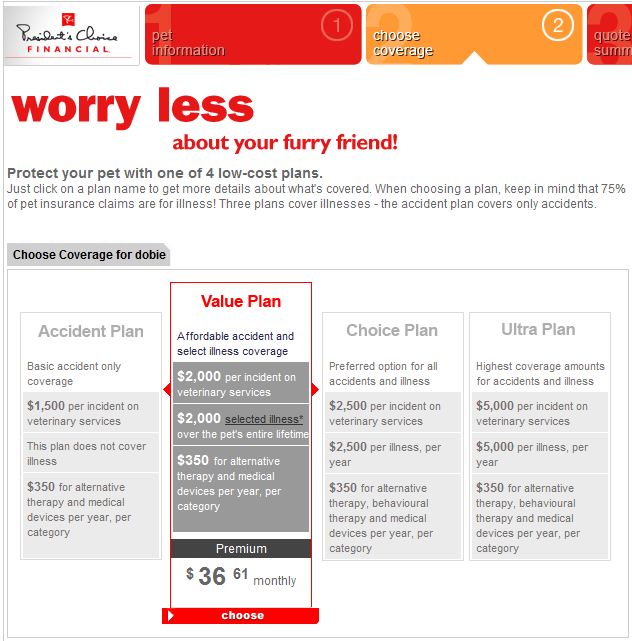
There are many pet insurance providers available and they all offer multiple tiers of coverage. Try to select the plan with the best value that suits your financial needs. The whole point of pet insurance is to ensure your pet receives the care he needs when accidents happen. If you can’t afford to pay the regular veterinary bills, you should not be a dog owner in the first place. That’s something that more people should consider before buying a dog. Insurance companies work because they make money off uneducated people paying for inflated plans that are filled with loopholes. Here are some comparisons for the least expensive plans offered by the top 3 pet insurance providers in Canada:

PetCare - Overpriced, too many exclusions, poor value, insurance has many loop holes to deny you coverage. Take a look at this:
Their least expensive plan is mainly for accident insurance. If you read carefully, you’ll realize that this QuickCare First Aid plan for dogs only covers $1000 for 7 types of accidents. If your accident is not one of the 7 types, they can deny you coverage. Their QuickCare Optimum plan is $38.15 per month but it only covers $1500 first-time illnesses per year.

SPCA Pet Insurance’s Intro Plan - hardly any coverage ($1000 per year) for $35+tax per month?! Ridiculous!
PC Financial’s Value Plan - only covers $2000 for SELECTED illness over the pet’s LIFETIME. How is this good value? Saving $40 a month for 5 years will give me over $2400.
PC Financial’s Accident Plan - $1500 per accident, $100 deductible, no annual limit for $10 a month. For half the price of PetCare’s plan, you get $500 more per accident. Doing the math, $10/month for 10 years is $1200. Just one accident during the lifetime of your pet and this plan is more than paid for. This is the clear winner. This plan works for me in combination with saving for rainy days. Instead of signing on for a $50/month plan, I can save $40/month for illnesses and have accident coverage.
Finally, a pet insurance policy I can live with!

Friday, October 28, 2011

Critical Socialization Period: 10-14 weeks

There is a period of development in all puppies which determine how they perceive new experiences as an adult. This is known as the Critical Socialization Period and it usually occurs between 10 - 14 weeks of age. During this time, the idea is to expose the puppy to as many new experiences as possible so that when the dog comes across a similar experience in the future, it will be able to adapt more quickly and with ease. In a way, we are establishing the baseline in the puppy’s mind for what are considered normal activities and behaviours.

Dobie will:
  • meet LOTS of people of varying age, gender and ethnicity
  • be exposed to a vacuum cleaner, hair dryer, dish washer, laundry machine
  • hear me dropping things on the floor, plates into the sink, letting cutlery fall on the counter
  • experience video game sounds and sights, television, radio
  • learn car riding manners
  • visit my parent’s house and yard
  • go to a mall, visit pet stores
  • go to cafes, patios, bubble tea take out
  • go to parks and playgrounds
  • experience grooming, taking baths, brushing teeth, trimming nails
  • listen to different types of music
  • visit the vet and get his shots
I have highlighted in orange the experiences which require extra caution and sometimes carrying the puppy to prevent him from coming in contact with other animals and their feces.

Here’s the catch, usually puppies are not fully immunized from diseases such as parvovirus and distemper until 16 weeks of age. However by then, the window for critical socialization is closed. My breeder likes to vaccinate at the early end of the accepted schedule in order for proper socialization to occur. Dobie will get his first set of shots at 7 weeks, the second set at 11 weeks and the 3rd set at 14 weeks instead of 16. Between the second and third vaccines, we need to be very careful where we take Dobie, but he will still be able to venture outside and his risk of infection is greatly reduced after receiving 2 vaccines. He still won’t be allowed to visit high dog-traffic areas such as pet stores or the vet office though. It is advised to pick up and carry your puppy when visiting these places. They still gain socialization from being in a new environment, without the unnecessary risk of contamination.

This one!

Dear Dobie,

Trying to find you in a litter of seven puppies was not an easy task. You gave Waldo a run for his money. I almost chose another puppy because you were too busy sniffing the floor. I hope this means that you will excel at tracking in the near future. Not to mention, when all the other puppies piled up to take their afternoon nap, you sat by yourself and chewed on an orange bear thingy. I don't mean to brag, but let's face it, I'm so proud of you already. Thank goodness you eventually came around to say hello and shoved the smaller puppy out of the way. When I picked you up I knew you were Dobie. I'm embarrassed to admit you're not the first puppy I put a collar on though. For over an hour I deliberated and felt that something was wrong until I removed his collar and gave it to you. Only then could I let out a sigh of relief and bring myself to leave the kennel. Here you are, at 6 weeks old with your very first (temporarily pink) collar!


I promise to take care of you to the very best of my ability. See you in 2 weeks!

Tuesday, October 18, 2011

Fear Imprint Period: 8-11 weeks

This is a tricky socialization period as it affects some dogs much more than others.  Dogs bred with stable temperaments and brave personalities may not be affected by the fear imprint period at all!  These are dogs where nothing seems to scare them.  But the vast majority of dogs will experience fear imprinting to some degree.  Between 8 - 11 weeks of age, the puppy is extra sensitive to fearful events.  If something frightens the puppy and his fear is confirmed by your actions, then he will remember for the rest of his life what frightened him.  He will also be careful to avoid the object or person who frightened him.

For example, say your puppy is following you around the kitchen and you accidentally knock over a baking sheet that makes a loud clash beside him.  This noise and the baking sheet falling from the sky would definitely scare the puppy.  If you laugh, pick up the baking sheet and ignore your puppy’s reaction, he will learn that there was nothing to be scared of.  However, if you drop what you’re doing and coddle the puppy, you have just confirmed his fear of the baking sheet.  From then on, he will avoid the baking sheet or that area of the kitchen.  This is the danger of the fear imprinting period.  Getting him to overcome his fear of the baking sheet later will be very difficult. So the best thing to do is avoid reassuring the puppy when he gets startled by something.  We can also be extra careful of our actions around the puppy.  Try to keep all learning experiences as positive as possible.

Tuesday, October 11, 2011

Thanksgiving visit to Garshangan Kennels

There is a lot to be thankful for this year.  For one, all the puppies in Dobie’s litter are healthy.  They have been weaned from Abba already and are eating a kibble and water mixture.  Abba is gorgeous again, her tummy has tucked up and it’s hard to tell she had a litter last month.  Jackson has a handsome face with kind eyes.  I will definitely keep an eye out for the puppy who resembles him the most.


In two weeks, I’ll be visiting again to choose my puppy.  They will be 6 weeks old, at which point their personalities become more evident.  The pups can also be ‘stacked’ (show dog stance) to check which dogs most conform to the breed standard.  I’m looking for a puppy with the following personality traits: alert, curious, neither the most dominant nor submissive pup of the litter, interested in chasing a ball, interested in playing tug and seeks interactions with me.  Basically, I am looking for a highly trainable dog with good drive for Schutzhund training.

Here is a video of the puppies at just 4 weeks of age.  They are already exploring outside the whelping box.  We had been playing with them for an hour prior to this footage, so they were all struggling to stay awake.  Some of the puppies fell asleep while sitting up!  As you can see, they all resemble each other in size, head shape, bone structure.  This is typical of line-bred dogs.